A general open question, if you think you may have an answer, please comment on this post. The question is simple.
Why do people trust Trump? Trump scores better than Clinton on some questions of trust, but why is that when there is so much evidence that he says things that are untrue?
Friday, September 9, 2016

Tuesday, September 6, 2016
A possible joint Basic Income proposal
A quick idea/proposal from me on a possible way Basic Income, or more accurately, a Guaranteed Minimum Income might work in Canada. Due to the fact that we split financial responsibility between the Federal and Provincial governments, there are challenges towards getting any such system up and running.
First some quick background on social assistance funding. Ontario Works (welfare) will give an individual $681 per month, and a couple $1077 per month. A couple with one child under 18 gets $1130, while an individual with two children under 18 gets $1004.
One problem with this is that in places like Toronto it can be difficult to find a place to rent for as little as $681 a month, not to mention buying food after paying for rent. It's also likely that a childless couple could easily share a single bedroom apartment, even if their food costs are double that of an individual.
As such I propose dividing up payments into three groups.
1 - Individuals (over age 18)
2 - Households
3 - Dependents (a sub-set of individuals, includes children)
I propose the "base" amount in all these calculations be $340 a month.
The Federal Government will fund the Household fee, and pay 3 times the base amount, monthly, to all heads of households all across Canada. This is $1020 a month.
Each Province meanwhile will fund both the dependent fee, and the individual fee, the base rate, $340 a month, to all individuals and dependents in the province.
Since each household contains, on average, 2.2 persons, this means the Federal government will be kicking in about 3/5ths of the funds for the program. Additionally, the more 'well off' provinces have larger households, while the 'poorer' provinces, have smaller households, meaning they will pay slightly less for this program.
An Individual living on their own, as head of their own household, will now get $1360 a month. A couple living on their own will get $1700, while a couple with a child gets $2040, the same amount an individual with two children would get.
The reason this would work financially is the same reason that a basic income would work. Ontario Works is supplemented by various other funds. Tax breaks apply to rent paid, a GST credit may be available. In addition to Ontario Works, as well as extra funds to pay for heating in the winter. People in Ontario with children can also receive $113 per child as a "baby bonus". Federally you could also get $533 for having a child as well. All of these programs require people to administrate them, each with their own rules and regulations, and each with their own 'bars' of entry. This new program would eliminate all of them, and replace them with a single united administration of a single fund.
To make this work, the fund would have a 2/3rds exclusive clawback. This means for every dollar you make though other means (IE working) that two thirds of this benefit is clawed back. The exclusive part means this is calculated after any and all other clawbacks, including taxes. As such you can never be 'worse off' for working. This contrasts with a more standard 50% non-exclusive clawback that can often combine with taxes and other clawbacks (such as legally mandated debt repayment) so that working means you have less money.
This would replace all social assistance funding, including pensions (the poorest pensioners would, in general, see an increase under this new system, of about $100-300 a month) The amounts agreed to could always be higher than what I propose, but I strongly recommend against being lower, as the level I propose is already far below the poverty line. These rates must be indexed to inflation/CPI. Once agreed, the Federal and all Provincial governments would sign their agreement, and neither the Federal nor the Provincial governments could ever go below this level. However. Either side could decide to go above this level and provide extra funding at their discretion. The Federal government would also be responsible for fully funding this in the Territories. There would also be nothing stopping either side from retaining certain social programs and thus providing extra funding for - for example - children. Should they decide to do this, however, they would be responsible for funding the program themselves.
First some quick background on social assistance funding. Ontario Works (welfare) will give an individual $681 per month, and a couple $1077 per month. A couple with one child under 18 gets $1130, while an individual with two children under 18 gets $1004.
One problem with this is that in places like Toronto it can be difficult to find a place to rent for as little as $681 a month, not to mention buying food after paying for rent. It's also likely that a childless couple could easily share a single bedroom apartment, even if their food costs are double that of an individual.
As such I propose dividing up payments into three groups.
1 - Individuals (over age 18)
2 - Households
3 - Dependents (a sub-set of individuals, includes children)
I propose the "base" amount in all these calculations be $340 a month.
The Federal Government will fund the Household fee, and pay 3 times the base amount, monthly, to all heads of households all across Canada. This is $1020 a month.
Each Province meanwhile will fund both the dependent fee, and the individual fee, the base rate, $340 a month, to all individuals and dependents in the province.
Since each household contains, on average, 2.2 persons, this means the Federal government will be kicking in about 3/5ths of the funds for the program. Additionally, the more 'well off' provinces have larger households, while the 'poorer' provinces, have smaller households, meaning they will pay slightly less for this program.
An Individual living on their own, as head of their own household, will now get $1360 a month. A couple living on their own will get $1700, while a couple with a child gets $2040, the same amount an individual with two children would get.
The reason this would work financially is the same reason that a basic income would work. Ontario Works is supplemented by various other funds. Tax breaks apply to rent paid, a GST credit may be available. In addition to Ontario Works, as well as extra funds to pay for heating in the winter. People in Ontario with children can also receive $113 per child as a "baby bonus". Federally you could also get $533 for having a child as well. All of these programs require people to administrate them, each with their own rules and regulations, and each with their own 'bars' of entry. This new program would eliminate all of them, and replace them with a single united administration of a single fund.
To make this work, the fund would have a 2/3rds exclusive clawback. This means for every dollar you make though other means (IE working) that two thirds of this benefit is clawed back. The exclusive part means this is calculated after any and all other clawbacks, including taxes. As such you can never be 'worse off' for working. This contrasts with a more standard 50% non-exclusive clawback that can often combine with taxes and other clawbacks (such as legally mandated debt repayment) so that working means you have less money.
This would replace all social assistance funding, including pensions (the poorest pensioners would, in general, see an increase under this new system, of about $100-300 a month) The amounts agreed to could always be higher than what I propose, but I strongly recommend against being lower, as the level I propose is already far below the poverty line. These rates must be indexed to inflation/CPI. Once agreed, the Federal and all Provincial governments would sign their agreement, and neither the Federal nor the Provincial governments could ever go below this level. However. Either side could decide to go above this level and provide extra funding at their discretion. The Federal government would also be responsible for fully funding this in the Territories. There would also be nothing stopping either side from retaining certain social programs and thus providing extra funding for - for example - children. Should they decide to do this, however, they would be responsible for funding the program themselves.
Monday, September 5, 2016
US Election; "Writ Drop"
If the US election were held using Canadian standards, today would be the "writ drop", the day the election legally begins. This is when polls begin to get far more accurate and frequent, when media coverage ramps up from it's current level to full (if that can be believed) and the "election season" kicks off.
As such I thought I'd do an "opening" update, showing where things stand as this election "begins"

To be clear about the colours: The darkest shades are states that are "solid" and will not be won by the other candidate. Medium shades indicates states that will probably be won, while light shades indicate states that could flip. Unfortunately, the mapping program, 270towin, does not allow for more shades, if it did, I could show how states like North Carolina are far more likely to switch than Georgia, and just how unlikely it is that Mississippi will switch.
The main purpose for this post is to simply set up this as the ground state; where things are starting, and to serve as a basis for future posts and as a point for comparison.
As of today, there are 63 days to the election.
As such I thought I'd do an "opening" update, showing where things stand as this election "begins"

To be clear about the colours: The darkest shades are states that are "solid" and will not be won by the other candidate. Medium shades indicates states that will probably be won, while light shades indicate states that could flip. Unfortunately, the mapping program, 270towin, does not allow for more shades, if it did, I could show how states like North Carolina are far more likely to switch than Georgia, and just how unlikely it is that Mississippi will switch.
The main purpose for this post is to simply set up this as the ground state; where things are starting, and to serve as a basis for future posts and as a point for comparison.
As of today, there are 63 days to the election.
Sunday, September 4, 2016
The case for Urban PR
After looking at the math, we should look at the politics. As you may have noticed, the Conservatives were over-represented. While the Tories do not win every rural riding, they do win a larger share of rural ridings than they do urban ridings. You may also notice the Greens were under-represented, this is a consequence of the small riding size (only 9 members) meaning that a party needs 11% to win a seat, and the Greens have yet to manage that over a large enough area. You'll also note my note about Simcoe County, which is that the math I've done shows results can be different. These three things are the key to allowing all 5 parties to back this. I will go one by one and examine why each party may, or may not, back this idea.
Proposal
First, we need to be very clear what 'idea' we are talking about. The 'idea' I am proposing is based on something said by Jean-Pierre Kingsley, who pointed out that in the past, many provinces have had a form of PR. When I'd first heard of it, I dismissed it, and disagreed with it; but the more I thought about it, I've started to come around. It's far from my preferred idea, but it's something that I do not hate.
The idea itself is as follows
1 - "Urban" areas containing 3 or more ridings are combined into multi-member ridings.
2 - These "Urban" ridings should match municipal boundaries when plausible.
3 - These ridings should aim to contain 5 members each, but could have as many as 9 or few as 3.
4 - These urban ridings will use STV. Each voter has 1 ballot and ranks candidates preferentially.
5 - Rural ridings will continue to use FPTP.
As such, urban ridings will be similar to what exists in Ireland.
Liberals
For the Liberal Party, this system allows them to achieve some of their goals. First off, the introduction of a preferential ballot in urban ridings will mean more Liberals elected. Even in my example, I did not do any STV calculations. As such, chances are we could see as many as 15 more Liberals win, and hence, possibly, retain their majority, though unlikely. This allows the Liberals to follow through on their promise to end FPTP, and due to the ranked ballot, likely improves the position of the party in all future elections compared to base PR. By adopting this, the party can claim a victory for Proportional Representation. It could also use this to justify making any further changes towards PR that would jeopardize the party's position. For a party that's yet to really take a stand for anything in particular on the electoral reform front, this allows the Liberals to sell this to caucus as well, telling the PR backers this is as good as it gets, and the FPTP backers that this is as little change as is possible.
Tories
For the Tories, a change from FPTP is risky. Keeping it in the rural areas of the country is an important selling point to them that will ensure they can back this. In fact, it is often the small c conservative party that walks away after an election with 0 seats in various large urban areas. This change means that will never happen again, as the Tories can be all but guaranteed MPs from large cities, only needing to win, for example, 20% of the vote to gain 1 MP in a 5 seat Riding. This can easily be sold as keeping bedrock blue ridings they way they are while allowing for the party to win previously unwinnable ridings. For the party, and their supporters, the fear of never having another Conservative majority again is what drives opposition to any change. By introducing a system that allows for a future Conservative majority, we can gain not just the party's members on the committee, and it's caucus in the house, but we can also gain the support of Conservative members and voters. This is crucial to winning any referendum on the issue.
NDP
For the NDP this might be the toughest sell. The party is strongly in favour of MMP-PR and will push for it whenever and wherever possible. For that reason, if the proposal I've outlined is moved forward, I strongly suspect the Liberals and Tories will use their combined majority on the committee to present the NDP with a difficult choice. They will make this proposal the only official proposal the committee is going to look at. In effect, they will tell the NDP to either back this proposal, or back nationwide FPTP. While the NDP will loudly complain, I suspect at the end of the day, they will comply, and back this proposal as well. As such, when this proposal leaves the committee, it will have the backing of all 3 of the national parties. I can also see the NDP backing this in a referendum, telling their supporters that some PR is better than no PR, and that the NDP will make MMP-PR a coalition issue after the first election using our new system (which will be more likely to produce minority governments).
Bloc
For the Bloc, seen as an anti-PR party, there is an important gain to be made. The Bloc, for many years, won 50%+1 of all seats in Quebec. If you look from that perspective, it makes little sense to change. However, in the last two elections the Bloc has won 4, and 10 seats, less than 1/7th of the seats in the province. While this system will mean that we won't be seeing the Bloc sweeping the province, it also means that during the difficult times, the party has a base of support it can rely on. It is thus guaranteed to always have at least a few MPs in the commons so long as this system remains in place. Additionally, this system means it's possible for an anglophone Bloc member to be elected as an MP for anglophone Montreal. This is something the party would very much like to achieve. As such, I could see the Bloc back this, especially given their past historical successes in rural Quebec.
Green
For the Greens, there seems to be no reason to back this on the surface, but that is when we get into something I've been eluding to for a while. My calculation is not a real election, it was a quick and dirty example. When New Zealand introduced Proportional Representation, voting patterns changed. We've also seen this in other areas that go from non-proportional to proportional systems. What that means, bluntly, is we could see the nationwide Green vote go from 5% to 10%. STV also means as candidates drop, the preference flows from other candidates can end up boosting someone to victory. With the Liberals and NDP being "parties of government" in many provinces, it's possible (likely in fact) that people may vote for a local Liberal/NDP MP they like #1, and preference a Green #2 because of perceptions of 'not caring' or outright corruption among the brass of their prefered party. The Greens, as such, would actually gain by a move to this new system, and would also be all but guaranteed a handful of MPs.
This is by no means a lock. It's quite possible no party will want to back this idea, especially if events back them into various corners. Nor is this the easiest path to a majority on the committee and in the commons. However; this is the most likely way to get all 5 parties on board, and to pass any referendum. Since it uses the existing map (simply 'clumping' existing ridings together) it is also something that can be done 'quickly' by the government, as oppose to having to take the time of redrawing the entire electoral map. When this has been used in the past in places like Manitoba and Alberta it has been abandoned after a few elections, but with more and more Canadians calling for PR, it's quite possible that when this system is replaced, it is replaced with another system that is far more proportional.
Proposal
First, we need to be very clear what 'idea' we are talking about. The 'idea' I am proposing is based on something said by Jean-Pierre Kingsley, who pointed out that in the past, many provinces have had a form of PR. When I'd first heard of it, I dismissed it, and disagreed with it; but the more I thought about it, I've started to come around. It's far from my preferred idea, but it's something that I do not hate.
The idea itself is as follows
1 - "Urban" areas containing 3 or more ridings are combined into multi-member ridings.
2 - These "Urban" ridings should match municipal boundaries when plausible.
3 - These ridings should aim to contain 5 members each, but could have as many as 9 or few as 3.
4 - These urban ridings will use STV. Each voter has 1 ballot and ranks candidates preferentially.
5 - Rural ridings will continue to use FPTP.
As such, urban ridings will be similar to what exists in Ireland.
Liberals
For the Liberal Party, this system allows them to achieve some of their goals. First off, the introduction of a preferential ballot in urban ridings will mean more Liberals elected. Even in my example, I did not do any STV calculations. As such, chances are we could see as many as 15 more Liberals win, and hence, possibly, retain their majority, though unlikely. This allows the Liberals to follow through on their promise to end FPTP, and due to the ranked ballot, likely improves the position of the party in all future elections compared to base PR. By adopting this, the party can claim a victory for Proportional Representation. It could also use this to justify making any further changes towards PR that would jeopardize the party's position. For a party that's yet to really take a stand for anything in particular on the electoral reform front, this allows the Liberals to sell this to caucus as well, telling the PR backers this is as good as it gets, and the FPTP backers that this is as little change as is possible.
Tories
For the Tories, a change from FPTP is risky. Keeping it in the rural areas of the country is an important selling point to them that will ensure they can back this. In fact, it is often the small c conservative party that walks away after an election with 0 seats in various large urban areas. This change means that will never happen again, as the Tories can be all but guaranteed MPs from large cities, only needing to win, for example, 20% of the vote to gain 1 MP in a 5 seat Riding. This can easily be sold as keeping bedrock blue ridings they way they are while allowing for the party to win previously unwinnable ridings. For the party, and their supporters, the fear of never having another Conservative majority again is what drives opposition to any change. By introducing a system that allows for a future Conservative majority, we can gain not just the party's members on the committee, and it's caucus in the house, but we can also gain the support of Conservative members and voters. This is crucial to winning any referendum on the issue.
NDP
For the NDP this might be the toughest sell. The party is strongly in favour of MMP-PR and will push for it whenever and wherever possible. For that reason, if the proposal I've outlined is moved forward, I strongly suspect the Liberals and Tories will use their combined majority on the committee to present the NDP with a difficult choice. They will make this proposal the only official proposal the committee is going to look at. In effect, they will tell the NDP to either back this proposal, or back nationwide FPTP. While the NDP will loudly complain, I suspect at the end of the day, they will comply, and back this proposal as well. As such, when this proposal leaves the committee, it will have the backing of all 3 of the national parties. I can also see the NDP backing this in a referendum, telling their supporters that some PR is better than no PR, and that the NDP will make MMP-PR a coalition issue after the first election using our new system (which will be more likely to produce minority governments).
Bloc
For the Bloc, seen as an anti-PR party, there is an important gain to be made. The Bloc, for many years, won 50%+1 of all seats in Quebec. If you look from that perspective, it makes little sense to change. However, in the last two elections the Bloc has won 4, and 10 seats, less than 1/7th of the seats in the province. While this system will mean that we won't be seeing the Bloc sweeping the province, it also means that during the difficult times, the party has a base of support it can rely on. It is thus guaranteed to always have at least a few MPs in the commons so long as this system remains in place. Additionally, this system means it's possible for an anglophone Bloc member to be elected as an MP for anglophone Montreal. This is something the party would very much like to achieve. As such, I could see the Bloc back this, especially given their past historical successes in rural Quebec.
Green
For the Greens, there seems to be no reason to back this on the surface, but that is when we get into something I've been eluding to for a while. My calculation is not a real election, it was a quick and dirty example. When New Zealand introduced Proportional Representation, voting patterns changed. We've also seen this in other areas that go from non-proportional to proportional systems. What that means, bluntly, is we could see the nationwide Green vote go from 5% to 10%. STV also means as candidates drop, the preference flows from other candidates can end up boosting someone to victory. With the Liberals and NDP being "parties of government" in many provinces, it's possible (likely in fact) that people may vote for a local Liberal/NDP MP they like #1, and preference a Green #2 because of perceptions of 'not caring' or outright corruption among the brass of their prefered party. The Greens, as such, would actually gain by a move to this new system, and would also be all but guaranteed a handful of MPs.
This is by no means a lock. It's quite possible no party will want to back this idea, especially if events back them into various corners. Nor is this the easiest path to a majority on the committee and in the commons. However; this is the most likely way to get all 5 parties on board, and to pass any referendum. Since it uses the existing map (simply 'clumping' existing ridings together) it is also something that can be done 'quickly' by the government, as oppose to having to take the time of redrawing the entire electoral map. When this has been used in the past in places like Manitoba and Alberta it has been abandoned after a few elections, but with more and more Canadians calling for PR, it's quite possible that when this system is replaced, it is replaced with another system that is far more proportional.
Saturday, September 3, 2016
Urban PR, what that might look like
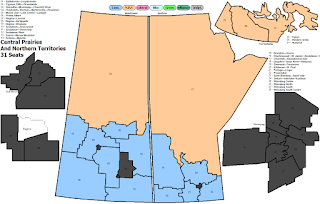
You may have noticed some errors with the last set of maps, as such, I've done updated maps, and these maps include what I see as likely PR/STV districts.


As eluded to in the description, I expect these would be STV, like Ireland, Australia's Senate, or the previous "BC-STV" proposal.
You'll note that for Montreal and Toronto, the colours indicate the multi-member ridings, while for the other maps, those multi-member ridings are shown in grayscale. Most provinces have both rural (single member) ridings and urban (multi member) ridings. Newfoundland and New Brunswick have no such 'urban' ridings, and Prince Edward Island has no such 'rural' ridings.
Nova Scotia and Manitoba both have a single "urban" riding, containing the capital. Saskatchewan has two, one for each large city. Alberta has 4 such ridings, two for each large city, while BC has 5, 4 in the greater Vancouver area, and one on part of Vancouver Island.
Quebec has 8 such ridings, none of which contain under 4 members, while Ontario has a whopping 16 urban ridings. All of these ridings in all of these provinces have between 3 and 9 members, trying to aim for 5 as a good balance. This is what's recommended for STV.
I'd like to examine how this would impact the last federal election. I'm going to make the presumption that rural ridings will be FPTP (though as I'll make clear in my next post, this isn't likely, but it is easier to calculate) and as opposed to straight out STV, I will presume the urban ridings use d'hondt PR, as that's easier to calculate as well. I will then compare this to both straight FPTP (IE the real results) and straight PR (IE nation-wide d'hondt) to show what this means.
Lets start at sunrise, in Newfoundland. Without any "urban" ridings, nothing changes. In Nova Scotia we have 4 ridings rolled into one. As such we lose 4 Liberal MPs to be replaced by the proportional results, which are 4 Liberals, and 1 New Democrat. This moves us on to PEI, which has a single province-wide riding. The 4 Liberal MPs are replaced with 3 Liberal MPs and a Tory MP.
As a result, in the Atlantic, we go from 32 Liberals to, to 30 Liberals, 1 Tory, and 1 New Democrat. The Atlantic, however, is not known for it's large urban areas, so, we'll hop over to the Prairies. Manitoba loses all 7 Liberal MPs and 1 NDP MP in Winnipeg, which is replaced with, 5 Liberals, 1 NDP MP, and 2 Tories.
In Saskatchewan we have two ridings. In Saskatoon, we replace 1 Tory MP with a Liberal (the other Tory, and New Democrat remain). In Regina the current balance would not change.
As a subtotal, we are currently down by 3 Liberals, and up by 2 Tories and 1 New Democrat. However, we've yet to hit urban areas that are both large and solidly for one party or another. As such, you can expect more change as we go.
In Alberta we have 4 multi-member ridings. South Calgary we exchange 1 Tory for a Liberal, and we do the same for the rest of Calgary, which gains 1 Liberal at the expense of a Tory. South Edmonton produces the same result, 1 additional Liberal at the expense of a Tory, while North Edmonton shakes things up by gaining us not only 1 Liberal, but also 1 New Democrat, both at the expense of Tories. As such Alberta produces 4 additional Liberals, and 1 additional New Democrat, whole losing 5 Tories, for a new subtotal of +1 Liberals, +2 New Democrats, and -3 Tories.
In BC we have a number of multi-member ridings. In the Capital Region, the Liberals gain 1 seat from the NDP. The sprawling north-shore coquitlam area would gain 2 Tories at the expense of the Liberals, white it's southern counterpart in the surrey-abbotsford area would gain 1 New Democrat from the Liberals. The Richmond-Delta-Burnaby area would gain 1 Tory at the expense of the New Democrats. Lastly Vancouver, which gains us a Tory at the expense of the Liberals, for a new subtotal of -2 Liberals, +1 New Democrats, and +1 Tories.
In Quebec City, we have the NDP gain 1 from the Tories. Our first big change comes from Laval, where the Liberals would lose a whopping 3 seats, one each to the NDP, Tories, and Bloc. The North Shore would also see huge changes. The Liberals would retain their seats, but the Bloc would lose 2 to the NDP, and 1 to the Tories. In the northern Monteregie area, the only change is 1 Bloc gain from the Liberals. This compares to the northern Monteregie area, where both the NDP and Bloc gain 1 from the Liberals. This brings us to a new subtotal of -8 Liberals, +6 New Democrats, +2 Tories, and +-0 Bloc
The Island of Montreal is large. The northern riding sees the Bloc and NDP gain 1 seat each from the Liberals. The Eastern riding sees the Bloc gain 1 from the NDP. The Western riding sees the Tories gain 1 from the Liberals. This brings us to a new subtotal of -11 Liberals, +6 New Democrats, +3 Tories, and +2 Bloc
In Ontario we have a large number of such ridings. Windsor sees the Liberals and Tories each gain 1 from the NDP. London gains 1 Tory from a Liberal, and Simcoe would gain 2 Liberals from 2 Tories. However Simcoe highlights a problem, as the NDP almost just wins a seat here, but on the math I'm using, just barely does not. Ottawa would see a gain of 1 each (NDP and Tory) from the Liberals. Durham would see 1 NDP gain from the Liberals, and they would do the same in the Niagara region. Both the Waterloo and Halton regions would see 1 NDP gain from the Liberals as well, while Hamilton sees no changes. Brampton sees 1 gain each, Mississauga sees 2 Tories and 1 NDP gained, all from Liberals. This brings us to a new subtotal of -20 Liberals, +11 New Democrats, +7 Tories, and +2 Bloc
The York Region and Toronto are all that's left. In the former we see a change with the NDP gaining 1, and the Tories gaining 2 from the Liberals. This leaves only Toronto, where the Liberals hold all the seats, and all gains will be from them. Etobicoke would see the Tories gain 1, while Scarborough sees 1 NDP gain, and 2 Tories. North York has 3 Tory gains, while the rest of Toronto has 3 New Democrat gains, and finally, a Tory gain. This brings us to a new subtotal of -35 Liberals, +16 New Democrats, +17 Tories, and +2 Bloc
The "election result" is thus:
149 - Lib
116 - Con
60 - NDP
12 - BQ
1 - Grn
The difference from this to the real results (and PR results) are as follows:
-35 (-14) Liberal
+17 (-7) Conservative
+16 (+7) New Democrats
+2 (+4) Bloc Quebecois
+-0 (+10) Green Party
As you can see this does have some of the impact of STV, in that smaller parties (IE the Greens) do not do well. Beyond that, our results are pretty close, we get "about 2/3rds" of the way towards a fully proportional system. (Unsurprising, as this is "about 2/3rds" of ridings that are impacted)
Tomorrow I'll explain the "politics" around this, and why each party could gain.


As eluded to in the description, I expect these would be STV, like Ireland, Australia's Senate, or the previous "BC-STV" proposal.
You'll note that for Montreal and Toronto, the colours indicate the multi-member ridings, while for the other maps, those multi-member ridings are shown in grayscale. Most provinces have both rural (single member) ridings and urban (multi member) ridings. Newfoundland and New Brunswick have no such 'urban' ridings, and Prince Edward Island has no such 'rural' ridings.
Nova Scotia and Manitoba both have a single "urban" riding, containing the capital. Saskatchewan has two, one for each large city. Alberta has 4 such ridings, two for each large city, while BC has 5, 4 in the greater Vancouver area, and one on part of Vancouver Island.
Quebec has 8 such ridings, none of which contain under 4 members, while Ontario has a whopping 16 urban ridings. All of these ridings in all of these provinces have between 3 and 9 members, trying to aim for 5 as a good balance. This is what's recommended for STV.
I'd like to examine how this would impact the last federal election. I'm going to make the presumption that rural ridings will be FPTP (though as I'll make clear in my next post, this isn't likely, but it is easier to calculate) and as opposed to straight out STV, I will presume the urban ridings use d'hondt PR, as that's easier to calculate as well. I will then compare this to both straight FPTP (IE the real results) and straight PR (IE nation-wide d'hondt) to show what this means.
Lets start at sunrise, in Newfoundland. Without any "urban" ridings, nothing changes. In Nova Scotia we have 4 ridings rolled into one. As such we lose 4 Liberal MPs to be replaced by the proportional results, which are 4 Liberals, and 1 New Democrat. This moves us on to PEI, which has a single province-wide riding. The 4 Liberal MPs are replaced with 3 Liberal MPs and a Tory MP.
As a result, in the Atlantic, we go from 32 Liberals to, to 30 Liberals, 1 Tory, and 1 New Democrat. The Atlantic, however, is not known for it's large urban areas, so, we'll hop over to the Prairies. Manitoba loses all 7 Liberal MPs and 1 NDP MP in Winnipeg, which is replaced with, 5 Liberals, 1 NDP MP, and 2 Tories.
In Saskatchewan we have two ridings. In Saskatoon, we replace 1 Tory MP with a Liberal (the other Tory, and New Democrat remain). In Regina the current balance would not change.
As a subtotal, we are currently down by 3 Liberals, and up by 2 Tories and 1 New Democrat. However, we've yet to hit urban areas that are both large and solidly for one party or another. As such, you can expect more change as we go.
In Alberta we have 4 multi-member ridings. South Calgary we exchange 1 Tory for a Liberal, and we do the same for the rest of Calgary, which gains 1 Liberal at the expense of a Tory. South Edmonton produces the same result, 1 additional Liberal at the expense of a Tory, while North Edmonton shakes things up by gaining us not only 1 Liberal, but also 1 New Democrat, both at the expense of Tories. As such Alberta produces 4 additional Liberals, and 1 additional New Democrat, whole losing 5 Tories, for a new subtotal of +1 Liberals, +2 New Democrats, and -3 Tories.
In BC we have a number of multi-member ridings. In the Capital Region, the Liberals gain 1 seat from the NDP. The sprawling north-shore coquitlam area would gain 2 Tories at the expense of the Liberals, white it's southern counterpart in the surrey-abbotsford area would gain 1 New Democrat from the Liberals. The Richmond-Delta-Burnaby area would gain 1 Tory at the expense of the New Democrats. Lastly Vancouver, which gains us a Tory at the expense of the Liberals, for a new subtotal of -2 Liberals, +1 New Democrats, and +1 Tories.
In Quebec City, we have the NDP gain 1 from the Tories. Our first big change comes from Laval, where the Liberals would lose a whopping 3 seats, one each to the NDP, Tories, and Bloc. The North Shore would also see huge changes. The Liberals would retain their seats, but the Bloc would lose 2 to the NDP, and 1 to the Tories. In the northern Monteregie area, the only change is 1 Bloc gain from the Liberals. This compares to the northern Monteregie area, where both the NDP and Bloc gain 1 from the Liberals. This brings us to a new subtotal of -8 Liberals, +6 New Democrats, +2 Tories, and +-0 Bloc
The Island of Montreal is large. The northern riding sees the Bloc and NDP gain 1 seat each from the Liberals. The Eastern riding sees the Bloc gain 1 from the NDP. The Western riding sees the Tories gain 1 from the Liberals. This brings us to a new subtotal of -11 Liberals, +6 New Democrats, +3 Tories, and +2 Bloc
In Ontario we have a large number of such ridings. Windsor sees the Liberals and Tories each gain 1 from the NDP. London gains 1 Tory from a Liberal, and Simcoe would gain 2 Liberals from 2 Tories. However Simcoe highlights a problem, as the NDP almost just wins a seat here, but on the math I'm using, just barely does not. Ottawa would see a gain of 1 each (NDP and Tory) from the Liberals. Durham would see 1 NDP gain from the Liberals, and they would do the same in the Niagara region. Both the Waterloo and Halton regions would see 1 NDP gain from the Liberals as well, while Hamilton sees no changes. Brampton sees 1 gain each, Mississauga sees 2 Tories and 1 NDP gained, all from Liberals. This brings us to a new subtotal of -20 Liberals, +11 New Democrats, +7 Tories, and +2 Bloc
The York Region and Toronto are all that's left. In the former we see a change with the NDP gaining 1, and the Tories gaining 2 from the Liberals. This leaves only Toronto, where the Liberals hold all the seats, and all gains will be from them. Etobicoke would see the Tories gain 1, while Scarborough sees 1 NDP gain, and 2 Tories. North York has 3 Tory gains, while the rest of Toronto has 3 New Democrat gains, and finally, a Tory gain. This brings us to a new subtotal of -35 Liberals, +16 New Democrats, +17 Tories, and +2 Bloc
The "election result" is thus:
149 - Lib
116 - Con
60 - NDP
12 - BQ
1 - Grn
The difference from this to the real results (and PR results) are as follows:
-35 (-14) Liberal
+17 (-7) Conservative
+16 (+7) New Democrats
+2 (+4) Bloc Quebecois
+-0 (+10) Green Party
As you can see this does have some of the impact of STV, in that smaller parties (IE the Greens) do not do well. Beyond that, our results are pretty close, we get "about 2/3rds" of the way towards a fully proportional system. (Unsurprising, as this is "about 2/3rds" of ridings that are impacted)
Tomorrow I'll explain the "politics" around this, and why each party could gain.
Friday, September 2, 2016
Electoral Reform; a proposal that could win support
I've given things some serious thought and I think I have a system that, possibly, could win the support of all 5 parties, as well as win in a nation wide referendum. Urban-PR. I plan to explain exactly why this is in a post over the weekend, however, I wanted to address a few basics. First, I'll introduce this with some maps. The darker areas would be proportional, while the rural areas would retain single-member districts.




I'll address one problem right now, and that is the idea that doing this would lead to endless conservative governments. Lets take a look at Saskatchewan in 2003. In the real election, the NDP won 30 seats, compared to 28 for the Saskatchewan Party. The NDP won on 44.63% of the vote, compared to only 39.35% for the Saskatchewan Party. The Liberals managed 14.18%, but at the time were seen as much closer to the NDP than the Saskatchewan Party.
Putting a system like this in place for Regina and Saskatoon, and using D'Hondt for the math, you'd end up with the following changes:
Rural Areas (FPTP)
25 - SKP - 48.6%
10 - NDP - 40.3%
00 - LIB - 11.2%
Regina (PR)
7 - NDP - 57.8% (11 FPTP)
3 - SKP - 26.1% (00 FPTP)
1 - LIB - 16.1% (00 FPTP)
Saskatoon (PR)
6 - NDP - 48.3% (9 FPTP)
4 - SKP - 29.8% (3 FPTP)
2 - LIB - 16.1% (0 FPTP)
Result:
32 - SKP - 39.4%
23 - NDP - 44.6%
03 - LIB - 14.2%
As you can see, this clearly boosts the conservative party in this race... however, this particular election was chosen for this reason. This is actually not as common as you may think, the maps above show that. Add to that the fact that rural ridings would likely not remain FPTP, and would likely become some form of alternative vote, and you can start to see the change. There are 4 ridings that I could see changing hands if Liberals heavily preferenced the NDP, the result would be as follows:
Result:
28 - SKP - 39.4%
27 - NDP - 44.6%
03 - LIB - 14.2%
While the Saskatchewan Party is still 'over-represented', they fail to obtain a majority, and as such, the Liberals would hold the balance of power.


(as well as the Atlantic with 32 Liberal seats)
I'll address one problem right now, and that is the idea that doing this would lead to endless conservative governments. Lets take a look at Saskatchewan in 2003. In the real election, the NDP won 30 seats, compared to 28 for the Saskatchewan Party. The NDP won on 44.63% of the vote, compared to only 39.35% for the Saskatchewan Party. The Liberals managed 14.18%, but at the time were seen as much closer to the NDP than the Saskatchewan Party.
Putting a system like this in place for Regina and Saskatoon, and using D'Hondt for the math, you'd end up with the following changes:
Rural Areas (FPTP)
25 - SKP - 48.6%
10 - NDP - 40.3%
00 - LIB - 11.2%
Regina (PR)
7 - NDP - 57.8% (11 FPTP)
3 - SKP - 26.1% (00 FPTP)
1 - LIB - 16.1% (00 FPTP)
Saskatoon (PR)
6 - NDP - 48.3% (9 FPTP)
4 - SKP - 29.8% (3 FPTP)
2 - LIB - 16.1% (0 FPTP)
Result:
32 - SKP - 39.4%
23 - NDP - 44.6%
03 - LIB - 14.2%
As you can see, this clearly boosts the conservative party in this race... however, this particular election was chosen for this reason. This is actually not as common as you may think, the maps above show that. Add to that the fact that rural ridings would likely not remain FPTP, and would likely become some form of alternative vote, and you can start to see the change. There are 4 ridings that I could see changing hands if Liberals heavily preferenced the NDP, the result would be as follows:
Result:
28 - SKP - 39.4%
27 - NDP - 44.6%
03 - LIB - 14.2%
While the Saskatchewan Party is still 'over-represented', they fail to obtain a majority, and as such, the Liberals would hold the balance of power.
Thursday, September 1, 2016
Germany: A very quick projection
Polls in Germany have been somewhat stable for a while, and as such, I thought I'd make a very quick projection.
161 - CDU (Conservative, only outside Bavaria)
133 - SPD (Social Democrat)
76 - AfD (Right-wing / Nationalist / Trumpist / Nativist)
76 - Linke (Left)
76 - Grn (Left / Environment)
38 - FPD (Liberal / Libertarian / Liberal-Conservative)
38 - CSU (Conservative, Bavaria only)
The CDU and CSU are in a permanent coalition, and the only option for the CDU/CSU to form a majority in this system is with the SPD, as they've previously said they are unwilling to work with AfD. As such, I expect the next parliament of Germany to look a bit like this:
332 - Government
76 - AfD
76 - Linke
76 - Grn
38 - FPD
It is, however, possible for FPD, a traditional coalition partner, to also be included. If so;
370 - Government
76 - AfD
76 - Linke
76 - Grn
161 - CDU (Conservative, only outside Bavaria)
133 - SPD (Social Democrat)
76 - AfD (Right-wing / Nationalist / Trumpist / Nativist)
76 - Linke (Left)
76 - Grn (Left / Environment)
38 - FPD (Liberal / Libertarian / Liberal-Conservative)
38 - CSU (Conservative, Bavaria only)
The CDU and CSU are in a permanent coalition, and the only option for the CDU/CSU to form a majority in this system is with the SPD, as they've previously said they are unwilling to work with AfD. As such, I expect the next parliament of Germany to look a bit like this:
332 - Government
76 - AfD
76 - Linke
76 - Grn
38 - FPD
It is, however, possible for FPD, a traditional coalition partner, to also be included. If so;
370 - Government
76 - AfD
76 - Linke
76 - Grn
Subscribe to:
Posts (Atom)