First a quick note: I've done some mild research, and leadership polls in Canada are useless more than a month or two out. With the Conservative leadership not expected to be decided until time some in 2017, that means we should take polls with a grain of salt. Patrick Brown in particular polled very poorly in early polls (despite his name being included) for the Ontario PC Party, and only took off after the leadership race really got underway.
However, there are some signs that leadership polls can indicate, in particular, they can give you a good idea of the candidates. Early polls tend to contain most of the final candidates, but they also usually miss one or two of them. As such I am refining my projection for the candidates of the CPC leadership:
Declared Candidates:
Maxime Bernier
Kellie Leitch
Candidates who have declared they will declare, but have yet to declare:
Michael Chong
Likely candidates:
Jason Kenney
Tony Clement
Peter MacKay
Possible Candidates:
Lisa Raitt
Unlikely Candidates:
Kevin O'Leary
"Dark Horse Candidates:
Doug Ford
Michelle Rempel
Gerard Deltell
Pierre Poilievre
Andrew Scheer
Friday, April 29, 2016

Thursday, April 28, 2016

Wednesday, April 27, 2016
Electoral Reform - Teddy's Crazy Proposal
I've tried two times before, and both times, I've failed to properly outline my proposal for electoral reform.
I figured the third time's the charm.
The first and most important change is to eliminate the Senate, the House of Commons, and the Supreme Court. To hammer home the point, the buildings housing these institutions should also be torn down.
Part of the problem I've had in the past when explaining this is people get confused. Bulldozing Parliament will help ensure this does not happen.
Next, we need to re-create the three branches of government.
JUDICIAL
The judicial branch actually works for the most part, so the old system will be brought back.
LEGISLATIVE
This is the branch of government which decides what is illegal and what is not.
As such, we will create a place called the "Legislature" to help determine which laws Canada will follow. This body should contain around 300-350 members, as Canada is used to dealing with assemblies of this size.
Elections to this body should be annual, to ensure that the elected members stay in close contact with the public.
The actual method of election is unimportant. It's not like these people make up the government. So I suppose hold a referendum on it, and see what people want, and just go with that.
EXECUTIVE
Now we are down to business. This is the branch that really matters.
The size of the assembly of the executive should be small, perhaps 72 members, or as many as 150. For this example, we will presume 72.
We shall call this assembly "Parliament"
Note that Parliament has nothing to do with the Legislature, and vice versa. the Legislature makes laws, it does not spend any money, nor does it approve any fiscal bills. If there is a dispute as to which branch a particular item belongs (for example, a proposal to tax criminals) the three branches together will decide, with a majority vote among the 3 being the final answer. In short, the supreme court will solve any disputes.
Parliament should have a term long enough to ensure it's policies have a chance to be enacted. Ideally, the term would be long, such as 5, or even 6 years, but given that Canada is a neighbour to a massive country that runs on 4 year executive terms, we shall sync our terms with theirs. As such elections will take place on the monday prior to victoria day, in 2020, 2024, and other years that are multiples of 4.
So why are we doing this? Simple
When Canadians go to vote, they ask themselves many questions. While sometimes the question may be "should gay marriage be legal" the questions tend to reflect the executive. How high should taxes be, what should we spend our money on, who should lead our country, etc.
This reform system will actually let people vote for what they think they are voting for.
Let me repeat: this sytem lets people vote for what people already think they are voting for.
Now that this is out of the way
How do we elect the Executive?
Well we'll take our 72 seats and divide it into two groups. The first group has 40 seats, while the second has 32.
Within that group of 32 seats, there is a further subdivision, with the larger group having 24 seats, and the smaller having 6.
We will call these groups "Group 1" with 40 seats, "Group 2" with 24, and "Group 3" with 8.
At election time, people are presented with the names of the various political parties contesting the election. Parties may, at their own discretion, submit additional possibilities, that include coalitions with other parties.
In the election itself, all the ballots are cast as a preferential ballot. Voters rank the parties (and coalition options) 1, 2, 3, 4, and so forth.
Next, a condorcet count is held. This means that all possible two party contests are tested. This means that each polling place will count the votes - on the first round - as though it is the final round, and do so more than once. The first test may be CPC vs LPC, followed by CPC vs NDP, followed by CPC vs GRN, etc etc etc. This is done until all results have been tested. This may take a week or more.
Once we are done, ideally, one party will beat all others in all matches. If there is no clear condorcet winner (IE someone winning all matches) it defaults to a simple preferential ballot with all parties contesting; the winner is then the party that wins the final round.
Once a "winner" is determined, that party is assigned all 40 "Group 1" seats, and becomes the "Government".
All ballots cast in the election that ranked the winner in the first slot are removed. In fact, lets burn them to avoid confusion. These ballots are burned.
The election is then contested again, now that these ballots are removed. The same methods are used to determine the "second winner" who is assigned all the "Group 2" seats, and becomes the "Official Opposition"
All ballots cast for this new winner are also burned. Then burned again.
A final round is conducted, where a final winner is determined. This winner is assigned all "Group 3" seats, and becomes the "Third Party"
After this we burn all the ballots because why not. In for a penny in for a pound, I suppose.
The parties then fill the slots assigned to them. Once filled, these slots are permanent. Only in the event of an emergency (defined as resignation of death of 25 or more members of Parliament) are these empty places filled. This gives the actual members power, as defections are not accounted for. As well the bar for replacement is low enough that the opposition can force it if and when needed.
In the event the Executive falls into emergency, it's powers are exercised jointly by agreement between the other two branches until emergency elections can be held.
Thoughts?
I figured the third time's the charm.
The first and most important change is to eliminate the Senate, the House of Commons, and the Supreme Court. To hammer home the point, the buildings housing these institutions should also be torn down.
Part of the problem I've had in the past when explaining this is people get confused. Bulldozing Parliament will help ensure this does not happen.
Next, we need to re-create the three branches of government.
JUDICIAL
The judicial branch actually works for the most part, so the old system will be brought back.
LEGISLATIVE
This is the branch of government which decides what is illegal and what is not.
As such, we will create a place called the "Legislature" to help determine which laws Canada will follow. This body should contain around 300-350 members, as Canada is used to dealing with assemblies of this size.
Elections to this body should be annual, to ensure that the elected members stay in close contact with the public.
The actual method of election is unimportant. It's not like these people make up the government. So I suppose hold a referendum on it, and see what people want, and just go with that.
EXECUTIVE
Now we are down to business. This is the branch that really matters.
The size of the assembly of the executive should be small, perhaps 72 members, or as many as 150. For this example, we will presume 72.
We shall call this assembly "Parliament"
Note that Parliament has nothing to do with the Legislature, and vice versa. the Legislature makes laws, it does not spend any money, nor does it approve any fiscal bills. If there is a dispute as to which branch a particular item belongs (for example, a proposal to tax criminals) the three branches together will decide, with a majority vote among the 3 being the final answer. In short, the supreme court will solve any disputes.
Parliament should have a term long enough to ensure it's policies have a chance to be enacted. Ideally, the term would be long, such as 5, or even 6 years, but given that Canada is a neighbour to a massive country that runs on 4 year executive terms, we shall sync our terms with theirs. As such elections will take place on the monday prior to victoria day, in 2020, 2024, and other years that are multiples of 4.
So why are we doing this? Simple
When Canadians go to vote, they ask themselves many questions. While sometimes the question may be "should gay marriage be legal" the questions tend to reflect the executive. How high should taxes be, what should we spend our money on, who should lead our country, etc.
This reform system will actually let people vote for what they think they are voting for.
Let me repeat: this sytem lets people vote for what people already think they are voting for.
Now that this is out of the way
How do we elect the Executive?
Well we'll take our 72 seats and divide it into two groups. The first group has 40 seats, while the second has 32.
Within that group of 32 seats, there is a further subdivision, with the larger group having 24 seats, and the smaller having 6.
We will call these groups "Group 1" with 40 seats, "Group 2" with 24, and "Group 3" with 8.
At election time, people are presented with the names of the various political parties contesting the election. Parties may, at their own discretion, submit additional possibilities, that include coalitions with other parties.
In the election itself, all the ballots are cast as a preferential ballot. Voters rank the parties (and coalition options) 1, 2, 3, 4, and so forth.
Next, a condorcet count is held. This means that all possible two party contests are tested. This means that each polling place will count the votes - on the first round - as though it is the final round, and do so more than once. The first test may be CPC vs LPC, followed by CPC vs NDP, followed by CPC vs GRN, etc etc etc. This is done until all results have been tested. This may take a week or more.
Once we are done, ideally, one party will beat all others in all matches. If there is no clear condorcet winner (IE someone winning all matches) it defaults to a simple preferential ballot with all parties contesting; the winner is then the party that wins the final round.
Once a "winner" is determined, that party is assigned all 40 "Group 1" seats, and becomes the "Government".
All ballots cast in the election that ranked the winner in the first slot are removed. In fact, lets burn them to avoid confusion. These ballots are burned.
The election is then contested again, now that these ballots are removed. The same methods are used to determine the "second winner" who is assigned all the "Group 2" seats, and becomes the "Official Opposition"
All ballots cast for this new winner are also burned. Then burned again.
A final round is conducted, where a final winner is determined. This winner is assigned all "Group 3" seats, and becomes the "Third Party"
After this we burn all the ballots because why not. In for a penny in for a pound, I suppose.
The parties then fill the slots assigned to them. Once filled, these slots are permanent. Only in the event of an emergency (defined as resignation of death of 25 or more members of Parliament) are these empty places filled. This gives the actual members power, as defections are not accounted for. As well the bar for replacement is low enough that the opposition can force it if and when needed.
In the event the Executive falls into emergency, it's powers are exercised jointly by agreement between the other two branches until emergency elections can be held.
Thoughts?
Tuesday, April 26, 2016
Manitoba Post-Mortem: Green Party
The Green Party had a pretty good election. Winnipeg can be added to the list of cities such as Victoria, Vancouver, and Calgary, where the party may one day see a breakthrough. Sadly for the Greens, they were unable to turn this into any seats.
Here are the seats the Green Party could have won if they had taken 4 times their vote:
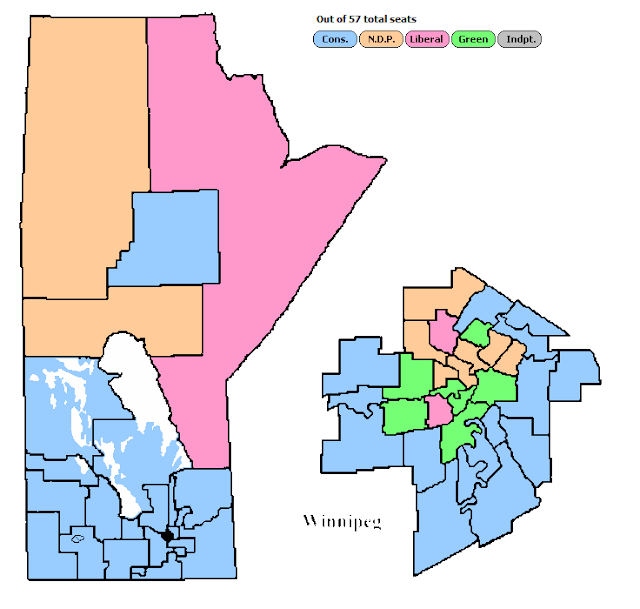
As you can see, the support for the party is concentrated in Winnipeg. In fact, due to the fact that so many ridings had no candidate,
This will be much shorter than the review of the Liberal showing. In short, the biggest mistakes of this campaign were not strategic but tactical. Beddome ran in the wrong riding, and a party that is missing about half it's possible candidates clearly has some other problems as well.
If the Greens plan to do better, they will need to step up their game. It's possible for them to do so, but not without years of hard work.
Here are the seats the Green Party could have won if they had taken 4 times their vote:

As you can see, the support for the party is concentrated in Winnipeg. In fact, due to the fact that so many ridings had no candidate,
This will be much shorter than the review of the Liberal showing. In short, the biggest mistakes of this campaign were not strategic but tactical. Beddome ran in the wrong riding, and a party that is missing about half it's possible candidates clearly has some other problems as well.
If the Greens plan to do better, they will need to step up their game. It's possible for them to do so, but not without years of hard work.
Monday, April 25, 2016
Thought: Splitting the Conservative Party
There is an interesting article from John Ivison in the National Post that I missed when it first came out.
Have a read of the article, and continue on after you've done so.
The claim in the article is that should MacKay become leader, the Conservative Party may re-split in two, the old PC Party and the old Reform Party.
It further implies that anyone from the old PC side could split the party should they take the leadership.
If I was a Conservative, I'd be highly offended by this. It implies that the party can only stay merged when half of it is subservient to the other half.
It implies that unless the PC Party does what the Reform Party wants, it will prevent it from ever getting in government.
I highly doubt this is the case. While there may be some in the Conservative Party that would leave, I can't see a radical change in politics. There are only a small number of options for those on the further right wing of the Tories
1 - Try to re-create the Reform Party. This new party would look an awful lot like a "Wildrose Party of Canada". Such a party would likely struggle to win very many seats, but could win a dozen in places like Alberta, BC and Saskatchewan.
2 - Join the Libertarians. This could gain some mileage, I could see the Libertarian Party, if it had sitting MPs, manage to at least re-elect them, if not gain; but fiscal differences between the wings within the CPC are just not that great.
3 - Join the Christian Heritage Party. While this party would be less successful at election time, it is more likely to see defections.
4 - The disgruntled MPs end up sitting as Independents.
Given this would mean destroying the Conservative Party, potentially preventing it from forming government, I don't see many MPs taking up this option, and if only a small number do, option 4 is most likely.
Have a read of the article, and continue on after you've done so.
The claim in the article is that should MacKay become leader, the Conservative Party may re-split in two, the old PC Party and the old Reform Party.
It further implies that anyone from the old PC side could split the party should they take the leadership.
If I was a Conservative, I'd be highly offended by this. It implies that the party can only stay merged when half of it is subservient to the other half.
It implies that unless the PC Party does what the Reform Party wants, it will prevent it from ever getting in government.
I highly doubt this is the case. While there may be some in the Conservative Party that would leave, I can't see a radical change in politics. There are only a small number of options for those on the further right wing of the Tories
1 - Try to re-create the Reform Party. This new party would look an awful lot like a "Wildrose Party of Canada". Such a party would likely struggle to win very many seats, but could win a dozen in places like Alberta, BC and Saskatchewan.
2 - Join the Libertarians. This could gain some mileage, I could see the Libertarian Party, if it had sitting MPs, manage to at least re-elect them, if not gain; but fiscal differences between the wings within the CPC are just not that great.
3 - Join the Christian Heritage Party. While this party would be less successful at election time, it is more likely to see defections.
4 - The disgruntled MPs end up sitting as Independents.
Given this would mean destroying the Conservative Party, potentially preventing it from forming government, I don't see many MPs taking up this option, and if only a small number do, option 4 is most likely.
Words
What is an omnibus bill? This article from CBC.ca attempts to look at that.
With this in mind, I have my own definitions for certain things. Definitions that, in some cases, are important, and I may want to reference from time to time.
Omnibus Bill: This is a bill that contains many different things that are mostly unrelated to one another. Now of course, just about everything the government does will require money, and so, you could argue that a budget bill should be coupled with just about any other bill, but most reasonable humans can see what is different and what is not. The article finds some difficulty finding things from the bill that are "different" - but they do find a few things.
Teddy's Conclusion: Trying to stuff different things into a single bill is what makes an Omnibus. This current budget is not one, nor are some (but not all) of the past CPC budgets.
Super Majority: This is a term media folks like to use without explaining what it is. What makes a majority so super? Well in the US Senate, that number may be 61, which means you can not filibuster. In the US House, 2/3rds, as this can over-ride a Veto. But in Canada? In Canada nothing different happens if you hold 51 seats in a 100 seat chamber, or if you hold 99 of those seats. Hence putting any sort of marker (2/3rd, 3/5ths, etc) is meaningless. What does hold meaning?
There actually is an answer. Take a look at this graphic to help you understand:
http://www.parl.gc.ca/parliamentarians/en/floorplan
Notice the dots. This indicates Cabinet. There are 31 of them. This means of the 184 Liberals, only 151 of them are non-cabinet "Liberals", but among these 151 are 186 "others" in the house, including the 31 members of Cabinet.
Teddy's Conclusion: A "Super Majority" in Canada is one where a party has so many members, that even if it's cabinet is not counted, it's members retain an overall majority of possible chamber seats. As such, Brian Pallister, with 12 cabinet members and a speaker, does not have a "super-majority" but Brad Wall does, as does Dwight Ball, and as may both PEI and Nova Scotia, depending on exactly how many people are officially in cabinet or not.
Strong or Weak Minority Government: People tend to use this to determine how easily a minority government will be able to function. For those from outside Canada, let me make clear: When there is an election, there is almost always a one-party government as a result. This means that if the results (in a 100 seat assembly) are 40-30-30, there is an assumption that the party with 40 seats will form a minority government without any coalition or any deals with either of the other two parties. This is different from europe, where the expectation may be the opposite.
That being said, the difference between weak and strong seem to be determined by ability to govern.
Teddy's Conclusion: This is determined by the position of the other parties. As such a strong majority is one where only one other party is needed to consent to pass a bill, while a weak one needs two or more. What determines what a "party" is (such as a 1-seat party in a 338 seat assembly) can be left to reasonable people being reasonable, but this is the basic difference.
Around: This applies to numbers. Saying that so-and-so party will take this or that many seats. That a party may take "around" 100 seats, or such. There is no clear definition, but I have some personal rules.
Teddy's Conclusion: When talking about any ole random number, my role is .5 and 2X. This means if I say "around a million bucks" that $2M or $500,000 are both within the range of what I'm talking about. This does not apply as much when it comes to seats in a legislature, the range is generally narrower, and there is no real number limit. What does matter is that other definition for other numbers, which I do and will continue to use often.
Impossible: This is the biggest problem word I run into. There seems to be this idea that things like the NDP winning Quebec or Alberta is and always was "impossible" This is simply not true. Some parties have the ability to grow.
Teddy's Conclusion: Growth is important. There is an indication of a few instances of growth across the country, in particular, with the Greens in places like BC, Ontario, and other provinces. A Green government in BC by 2026 is not "impossible". The NDP also could win a majority in any province, on any level, given the right circumstances. Tories and Liberals could also win any province on a federal level. Provincially the Tories could win almost every province excepting those where a right-of-centre party already exists, such as BC (Liberals), Quebec (CAQ), Saskatchewan (Sask Party), and Yukon (Yukon Party), while the Liberals could win everywhere except the Prairies, where there are some deep structural problems (and bluntly, they already have)
Much less is impossible than you think. If you count extreme vote splits and defections, the Greens could a plurality of seats, provincially, in every province excepting Newfoundland, Quebec, and Saskatchewan.
In closing, I also want to include a list of "possible" in the next 4 or 5 years
FEDERAL
A new party on the left that is successful in winning seats
This will not happen without taking huge chunks of sitting MPs out of the Liberals and/or NDP.
A new party on the right that is successful in winning seats
This is possible
A new party in Quebec that is successful in winning seats
Only if they displace the Bloc
The Greens growing
30 seats in the next election? Maybe. More is iffy, 45-50 at absolute most.
The NDP vanishing
For the NDP to take 8 or less ridings you'd really need to see this clearly going to another party, this would either mean a significant growth in the Green vote, or, a clear move to the Liberals to the left.
The Tories vanishing
Won't happen. You'd need to totally replace the right-wing vote with a new right-wing party.
The Liberals vanishing
If this happens you'll know, it'd take weeks, if not months, of daily newspaper headlines for the entire party to vanish. Is it possible? Yes, but not bloody likely.
NDP government
Yes. Minority. I can't see a majority in the next election though, but if Trudeau leaves, or, gets caught in a HUGE scandal (larger than sponsorship) maybe
Tory government
Yes. Period. Minority and Majority.
Liberal Super-Majority
Yes. Period.
Bloc Return
eh...under the right circumstances, yes. Again, you'd know about it, as you'd hear about this in the news. It would be a "big thing". Otherwise their hard-cap is about 20-25, but if we get into some other wedge issue that pits Quebec against "Canada", then yes, we can certainly see the Bloc climbing back up to 50 or more seats.
Provincial:
In the next election, the only parties that can win are either current incumbents or official oppositions. There are some caveats:
BC - With the right vote splits, the Greens could manage a minority. They could also take a minority if there is some huge scandal that rocks one or both of the other parties.
AB - If the "progressive voter" were to shift, we could see a different result in the next election. Regardless, the PC Party could still return, and as such, all 3 major parties have the potential to win the next election.
MB - We would need to see some kind of massive change (like MLA's defecting, or a massive corruption scandal) but if we do, we could see a Liberal win here in the 2020 election.
ON - If the Liberals drop the (progressive) ball, we could see the NDP pick it up and run with it. So far, we see no sign of this. If it does happen, however (like if the NDP proposes a basic income) we could still see an NDP win.
QC - Any of the 3 major parties could win. The Quebec NDP could also win, if they, you know, become an actual operating party.
I hope this clears some things up.
With this in mind, I have my own definitions for certain things. Definitions that, in some cases, are important, and I may want to reference from time to time.
Omnibus Bill: This is a bill that contains many different things that are mostly unrelated to one another. Now of course, just about everything the government does will require money, and so, you could argue that a budget bill should be coupled with just about any other bill, but most reasonable humans can see what is different and what is not. The article finds some difficulty finding things from the bill that are "different" - but they do find a few things.
Teddy's Conclusion: Trying to stuff different things into a single bill is what makes an Omnibus. This current budget is not one, nor are some (but not all) of the past CPC budgets.
Super Majority: This is a term media folks like to use without explaining what it is. What makes a majority so super? Well in the US Senate, that number may be 61, which means you can not filibuster. In the US House, 2/3rds, as this can over-ride a Veto. But in Canada? In Canada nothing different happens if you hold 51 seats in a 100 seat chamber, or if you hold 99 of those seats. Hence putting any sort of marker (2/3rd, 3/5ths, etc) is meaningless. What does hold meaning?
There actually is an answer. Take a look at this graphic to help you understand:
http://www.parl.gc.ca/parliamentarians/en/floorplan
Notice the dots. This indicates Cabinet. There are 31 of them. This means of the 184 Liberals, only 151 of them are non-cabinet "Liberals", but among these 151 are 186 "others" in the house, including the 31 members of Cabinet.
Teddy's Conclusion: A "Super Majority" in Canada is one where a party has so many members, that even if it's cabinet is not counted, it's members retain an overall majority of possible chamber seats. As such, Brian Pallister, with 12 cabinet members and a speaker, does not have a "super-majority" but Brad Wall does, as does Dwight Ball, and as may both PEI and Nova Scotia, depending on exactly how many people are officially in cabinet or not.
Strong or Weak Minority Government: People tend to use this to determine how easily a minority government will be able to function. For those from outside Canada, let me make clear: When there is an election, there is almost always a one-party government as a result. This means that if the results (in a 100 seat assembly) are 40-30-30, there is an assumption that the party with 40 seats will form a minority government without any coalition or any deals with either of the other two parties. This is different from europe, where the expectation may be the opposite.
That being said, the difference between weak and strong seem to be determined by ability to govern.
Teddy's Conclusion: This is determined by the position of the other parties. As such a strong majority is one where only one other party is needed to consent to pass a bill, while a weak one needs two or more. What determines what a "party" is (such as a 1-seat party in a 338 seat assembly) can be left to reasonable people being reasonable, but this is the basic difference.
Around: This applies to numbers. Saying that so-and-so party will take this or that many seats. That a party may take "around" 100 seats, or such. There is no clear definition, but I have some personal rules.
Teddy's Conclusion: When talking about any ole random number, my role is .5 and 2X. This means if I say "around a million bucks" that $2M or $500,000 are both within the range of what I'm talking about. This does not apply as much when it comes to seats in a legislature, the range is generally narrower, and there is no real number limit. What does matter is that other definition for other numbers, which I do and will continue to use often.
Impossible: This is the biggest problem word I run into. There seems to be this idea that things like the NDP winning Quebec or Alberta is and always was "impossible" This is simply not true. Some parties have the ability to grow.
Teddy's Conclusion: Growth is important. There is an indication of a few instances of growth across the country, in particular, with the Greens in places like BC, Ontario, and other provinces. A Green government in BC by 2026 is not "impossible". The NDP also could win a majority in any province, on any level, given the right circumstances. Tories and Liberals could also win any province on a federal level. Provincially the Tories could win almost every province excepting those where a right-of-centre party already exists, such as BC (Liberals), Quebec (CAQ), Saskatchewan (Sask Party), and Yukon (Yukon Party), while the Liberals could win everywhere except the Prairies, where there are some deep structural problems (and bluntly, they already have)
Much less is impossible than you think. If you count extreme vote splits and defections, the Greens could a plurality of seats, provincially, in every province excepting Newfoundland, Quebec, and Saskatchewan.
In closing, I also want to include a list of "possible" in the next 4 or 5 years
FEDERAL
A new party on the left that is successful in winning seats
This will not happen without taking huge chunks of sitting MPs out of the Liberals and/or NDP.
A new party on the right that is successful in winning seats
This is possible
A new party in Quebec that is successful in winning seats
Only if they displace the Bloc
The Greens growing
30 seats in the next election? Maybe. More is iffy, 45-50 at absolute most.
The NDP vanishing
For the NDP to take 8 or less ridings you'd really need to see this clearly going to another party, this would either mean a significant growth in the Green vote, or, a clear move to the Liberals to the left.
The Tories vanishing
Won't happen. You'd need to totally replace the right-wing vote with a new right-wing party.
The Liberals vanishing
If this happens you'll know, it'd take weeks, if not months, of daily newspaper headlines for the entire party to vanish. Is it possible? Yes, but not bloody likely.
NDP government
Yes. Minority. I can't see a majority in the next election though, but if Trudeau leaves, or, gets caught in a HUGE scandal (larger than sponsorship) maybe
Tory government
Yes. Period. Minority and Majority.
Liberal Super-Majority
Yes. Period.
Bloc Return
eh...under the right circumstances, yes. Again, you'd know about it, as you'd hear about this in the news. It would be a "big thing". Otherwise their hard-cap is about 20-25, but if we get into some other wedge issue that pits Quebec against "Canada", then yes, we can certainly see the Bloc climbing back up to 50 or more seats.
Provincial:
In the next election, the only parties that can win are either current incumbents or official oppositions. There are some caveats:
BC - With the right vote splits, the Greens could manage a minority. They could also take a minority if there is some huge scandal that rocks one or both of the other parties.
AB - If the "progressive voter" were to shift, we could see a different result in the next election. Regardless, the PC Party could still return, and as such, all 3 major parties have the potential to win the next election.
MB - We would need to see some kind of massive change (like MLA's defecting, or a massive corruption scandal) but if we do, we could see a Liberal win here in the 2020 election.
ON - If the Liberals drop the (progressive) ball, we could see the NDP pick it up and run with it. So far, we see no sign of this. If it does happen, however (like if the NDP proposes a basic income) we could still see an NDP win.
QC - Any of the 3 major parties could win. The Quebec NDP could also win, if they, you know, become an actual operating party.
I hope this clears some things up.
Subscribe to:
Posts (Atom)